
What is the best garage floor coating for a Utah garage?
For most Utah garages, the best garage floor coating is a full flake hybrid. That means an epoxy base, color flake and a clear polyaspartic or urethane top coat over a diamond ground slab. The top coat takes the road salt and hot tires. Paint and thin store kits cost less, but hot tires lift them.
Complete Concrete Coatings installs that system on Wasatch Front garages, so we have a stake in the answer. You can see how we build it on our full flake garage floor coatings page. Every cost below is a national market range from the guide named in its row. A real number for your floor needs an on-site look.
How do the garage floor options rank for a Utah garage?
For a Utah garage that parks cars, the full flake hybrid ranks first. A full polyaspartic or polyurea system comes second, then plain solid color epoxy. Polished concrete, a penetrating sealer, tiles and mats each fit narrower jobs. A thin DIY kit and floor paint come last, because hot tires and brine get through them first.
| Rank | Option | Market cost (source) | Life or wear (source) |
|---|---|---|---|
| 1 | Full flake hybrid: epoxy base, color flake, clear polyaspartic or urethane top coat | $4 to over $12 per sq ft for a layered epoxy system with a broadcast layer and top coat (Concrete Network) | 15 years or longer if properly installed and maintained (Concrete Network) |
| 2 | Full polyaspartic or polyurea, sold as a 1 day floor | $5 to $10 per sq ft for polyurea (HomeGuide) | 10 to 20 years or more (HomeGuide) |
| 3 | Plain solid color epoxy, 100 percent solids | $4 to $10 per sq ft for epoxy (HomeGuide) | Up to 20 years when properly installed (Concrete Network) |
| 4 | Metallic epoxy | Metallic tint costs extra over plain epoxy (HomeGuide) | A look for a space you show off (our flake color guide) |
| 5 | Polished concrete | $8 to $15 or more per sq ft on floors under 1,000 sq ft (HomeGuide) | The polish can last a lifetime; a stain guard sealer gets redone every 2 to 5 years (HomeGuide) |
| 6 | Penetrating concrete sealer | $1 to $3 per sq ft for concrete sealing (HomeGuide) | Around 10 years for a siloxane (our sealing page) |
| 7 | Interlocking garage tiles | $2 to $5 per sq ft, installed yourself (HomeGuide) | May trap moisture underneath (HomeGuide) |
| 8 | Roll-out rubber mats | $1 to $5 per sq ft, materials only (HomeAdvisor) | Petroleum from cars can break them down over time (HomeAdvisor) |
| 9 | Water based DIY epoxy kit | $200 to $700 per premade kit (HomeGuide) | Hot tires soften a thin kit and lift it (our garage page) |
| 10 | Garage floor paint, latex or one-part epoxy | $2 to $4 per sq ft installed (Fixr) | A year or two for latex, at least 3 to 4 years for one-part epoxy paint (Concrete Network) |
The ranges come from different guides, so read each row as a ballpark. Prep and garage size move every one of them. The full price breakdown is in what an epoxy garage floor costs in Utah. Lifespan depends on prep as much as product. How long a garage floor coating lasts in Utah covers it system by system.
Which options hold up to Utah salt, sun and hot tires?
Utah garage floors take five hits: hot tires, salt brine, sun at an open door, damp slabs and cold. The full flake hybrid covers the first four in one sheet you can mop. Cold just means booking a warm stretch or heating the garage for the install.
| Option | Hot tires | Road salt and brine | Sun at an open west door | Damp slab | Cold weather install |
|---|---|---|---|---|---|
| Full flake hybrid | Clear top coat takes it | Brine stays on top, where a mop gets it | Clear top coat holds its color | Moisture test, then a vapor barrier coat if damp | Epoxy base needs a warm slab |
| Full polyaspartic or polyurea | Polyaspartic takes it | Polyaspartic takes it | Polyaspartic holds its color | Least forgiving; test first | Polyaspartic is rated cooler than epoxy |
| Plain solid color epoxy | Prone to hot tire pickup | Keeps brine on top once cured | Ambers where the sun lands | Moisture test, then a vapor barrier coat if damp | Needs a warm slab |
| Polished concrete | No film to lift | Brine soaks into open concrete | No film to yellow | Lets vapor pass through | No film to cure |
| Penetrating sealer | No film to lift | Holds up, since it sits below the surface | No film to yellow | Goes on a dry slab only | 50 to 90 degrees, dry slab |
| Tiles or roll-out mats | Nothing bonded to lift | Brine can sit under tiles | Check the maker’s rating | Tiles may trap moisture | No cure; they snap or roll into place |
| Thin DIY kit or floor paint | Softens and lifts with the tread | Wears through, then brine reaches the slab | Epoxy kits amber like any epoxy | Vapor pushes thin films off | Warm, dry days only |
A west facing door is the hard case for sun. Afternoon light lands on the same strip of floor whenever the door is up, and plain epoxy ambers there first. A clear polyaspartic top coat holds its color, which is a big reason it goes on top.
The sealer and polished rows look strong in this table, and both have a place. Both leave the floor reading as concrete, though, and HomeGuide notes polished concrete is not completely stain proof. A coating is one solid sheet, so oil and dirt sit on top instead of soaking in.
Why is the full flake hybrid the pick for most Utah garages?
Each layer does one job. The epoxy base bonds to the ground slab and holds the flake. The flake hides small flaws and adds grip. The clear polyaspartic or urethane top coat takes the hot tires and road salt. Most garages get the whole system in 1 day.
That is why a full flake floor with a polyaspartic top coat ranks above plain solid color epoxy. A mid tone flake blend also hides the pale salt film that comes home on the tires. A solid color shows it.
The system only works on a prepared slab. We run diamond grinders over the whole floor and fill cracks and chipped edges. Where the slab sits below grade or shows damp patches, we test for moisture first. A damp slab gets a vapor barrier product under the color.
When does a full polyaspartic or polyurea floor make sense?
It makes sense on a dry slab when speed matters most. HomeGuide prices polyurea at $5 to $10 per square foot and says it takes 1 day to cure. The catch is a damp slab. Polyaspartic is less tolerant of moisture vapor than epoxy, which is one reason most base coats stay epoxy.
The 1 day pitch is real, but these systems do not own it. Most hybrid garages are a 1 day job too. The crew grinds in the morning, lays the epoxy base and flake, then puts the clear top coat down. How epoxy and polyaspartic split the work, layer by layer, is in our epoxy vs polyaspartic comparison.
Is plain solid color or metallic epoxy enough for a garage?
Plain solid color epoxy is a real floor. Concrete Network says 100 percent solids epoxy can last up to 20 years when properly installed. In a Utah garage it lacks two things the hybrid has. Flake adds grip and hides salt film. A hard clear top coat stands up to sun and hot tires.
Standard epoxy ambers under sun and is prone to hot tire pickup. A plain floor near an open door shows both first. A solid color reads cleaner in a shop than in a garage that takes a wet car all winter.
Metallic epoxy is a look. Metallic pigment goes into clear epoxy and gets moved while it is wet. Every floor comes out one of a kind. We install metallic epoxy flooring in garages. It suits a garage you show off more than one that takes salt every day. HomeGuide lists metallic tint as an add-on that costs extra over plain epoxy.
Why do floor paint and thin kits rank last?
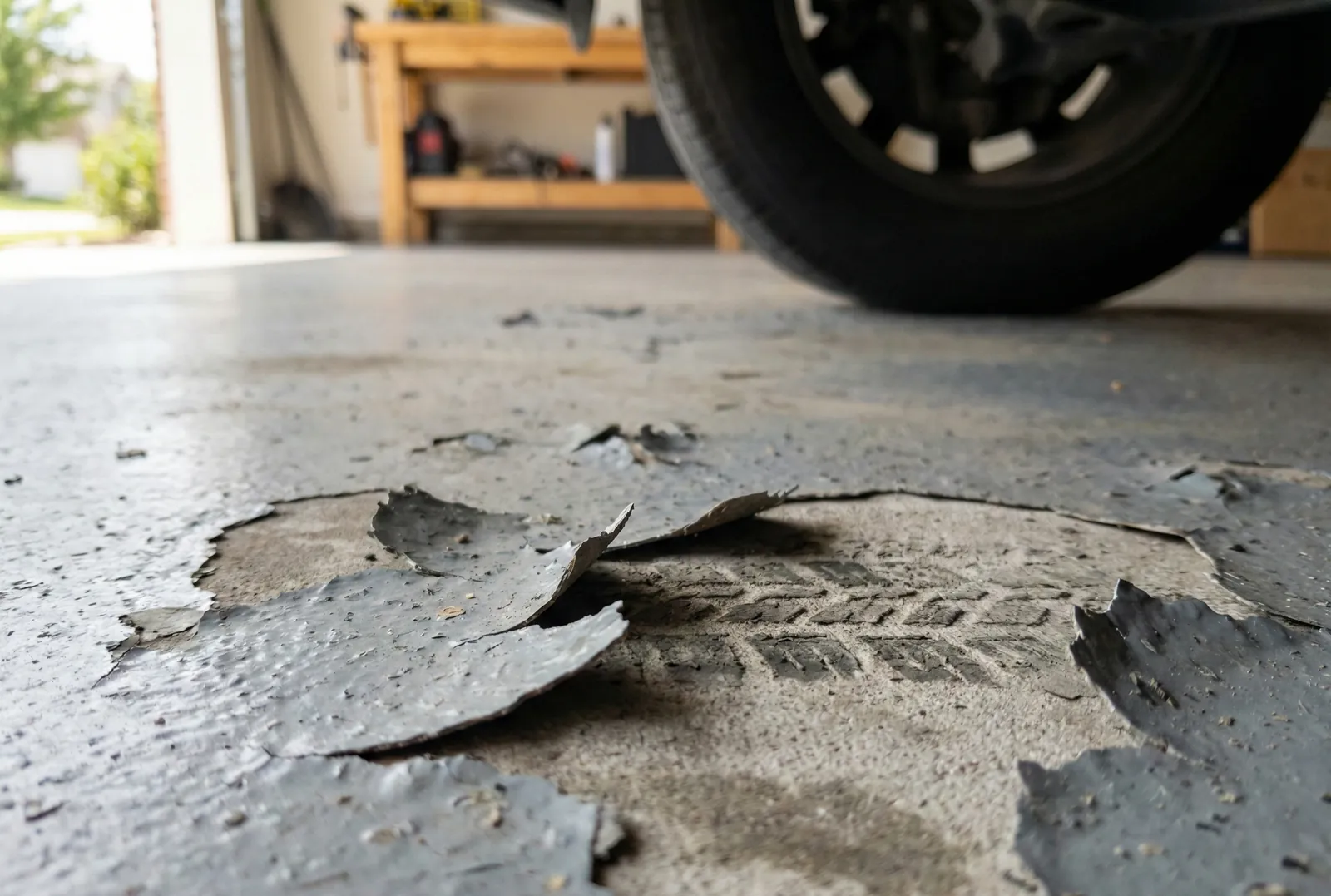
Both are thin, and a Utah garage is hard on thin films. Fixr puts installed floor paint at $2 to $4 per square foot. Concrete Network says latex floor paint often peels up from hot car tires. A thin DIY kit softens under summer tire heat and lifts with the tread.
Concrete Network suggests paint mainly for a garage used for storage or occasional parking. That is a fair use for it. A garage that takes a wet, salty car all winter needs more coating than paint or a kit puts down.
When a failed kit comes to us, we grind the old kit off down to bare concrete first. A new coat will not stick to a lifting one. The money spent on the kit buys nothing toward the floor that replaces it.
Should you seal, polish or cover the slab instead?
Sometimes. A penetrating sealer is the light option, at $1 to $3 per square foot in HomeGuide’s guide. A siloxane holds for around 10 years. Polished concrete suits a dry warehouse or showroom more than a salted garage. Interlocking tiles sit loose on the slab, and HomeGuide notes they may trap moisture.
A penetrating sealer soaks in and works from inside the pores. It does not peel, and it holds up to road salt. The slab keeps its bare concrete look. A penetrating concrete sealer is our usual pick for a driveway, a walkway or an exposed patio. Inside the garage, a coated floor is the longer lasting answer. If the driveway outside is still bare, fall is the time to get your concrete sealed before winter.
Polishing grinds the slab you already own and hardens it, so there is no film to peel or yellow. HomeGuide prices floors under 1,000 square feet at $8 to $15 or more per square foot. A 2 car garage sits well under that size. The catch is salt. Road salt and de-icer soak into open concrete, so a polished garage needs a guard coat and more frequent cleaning. Our look at polished concrete versus epoxy covers garages, basements and shops.
Tiles and mats lie over the slab instead of bonding to it. HomeGuide puts interlocking tiles at about $800 to $2,900 for a 2 car garage, installed yourself. It notes that tiles can be removed. HomeAdvisor puts rolled rubber mats at $1 to $5 per square foot for materials. It says they work well for garage gyms or tool bench areas. It also warns that petroleum from cars can break them down over time. The concrete under either one stays bare.
What happens at a free garage floor estimate?
We come to the garage and look at the bare slab. We measure it, check the cracks and edges, and test for moisture where the concrete looks damp. Then we show flake colors and explain which top coat suits how you use the space. You get a written number for that floor before we leave.
The ranges above are national market figures from the guides named in each row. A real number for your garage needs an on-site look at the slab, its cracks and any old coating.
If your garage floor is bare or peeling from an old kit, book a free on-site estimate. The office takes calls at (801) 347-4518, Monday to Friday, 8am to 5pm.