
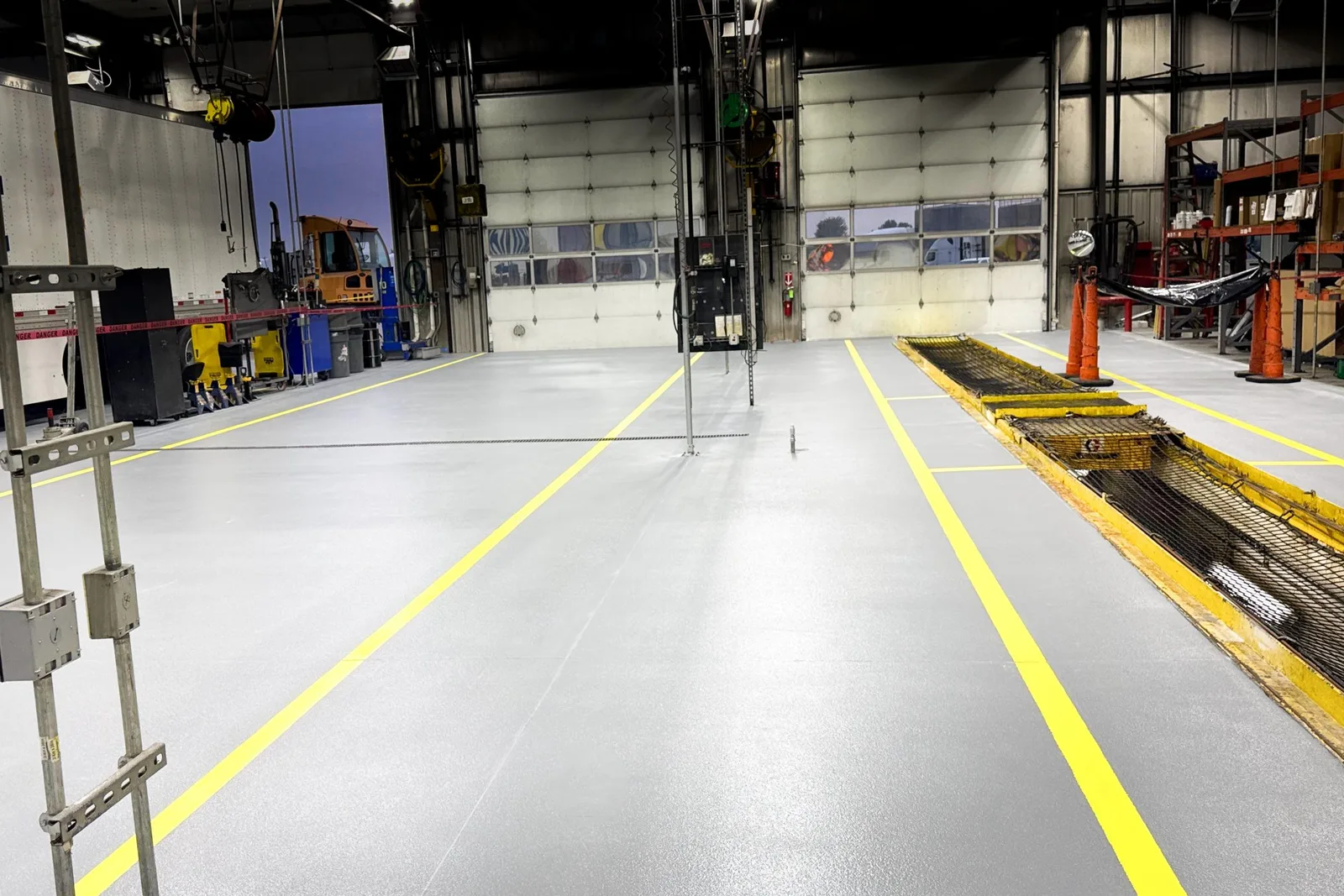
What is the best industrial epoxy floor coating for a Utah warehouse or shop?
The best industrial epoxy floor coating for most Utah warehouses and shops is 100 percent solids epoxy. It goes over a ground and repaired slab. Forklift aisles get thicker mortar epoxy. A fast polyaspartic or polyurea topcoat goes on where downtime costs money. Kitchens with daily hot washdowns call for urethane cement. A dry, sound slab may only need polishing.
We install commercial and industrial epoxy flooring in warehouses, shops, hangars and kitchens along the Wasatch Front. Every system below is a market option, and each table row names the manufacturer or cost guide behind it. The cost figures are national ranges, not our prices. The slab and the work on it decide the build, so we look at both before quoting.
What are the industrial floor coating options?
Eight options cover most warehouse and shop floors. Self-leveling epoxy, mortar epoxy, broadcast quartz or flake, novolac, anti-static epoxy and urethane cement are the base builds. Polyaspartic and polyurea are fast topcoats that go over a base. Polished concrete is the one option with no coating on top at all.
| Option | Where it fits | Strengths | Limits | Source |
|---|---|---|---|---|
| Self-leveling 100 percent solids epoxy | Warehouse floors, storage rooms, showrooms | Flows out flat into a seamless floor; solid epoxy is the grade used in commercial and industrial buildings | Much harder to apply; not for a slab with moisture problems unless a vapor barrier coat goes first | HomeGuide, HomeAdvisor |
| Epoxy mortar (trowel-down) | Forklift aisles, loading docks, rough or worn slabs | Epoxy mixed with a dry filler and troweled on thick, built for wheel loads | Costs more than plain self-leveling epoxy | Sika data sheet |
| Broadcast quartz or flake epoxy | Wet entries, wash areas, locker rooms, shop floors | Aggregate in the wet epoxy adds grip and color; Sika publishes textured builds for improved slip resistance | Rougher texture grips better and takes more scrubbing | Sika data sheet |
| Novolac epoxy | Chemical storage, secondary containment, treatment plants | Highly cross-linked epoxy that resists strong acids, solvents and caustics | Slow to full service: 3 to 5 days on one data sheet | Epoxy.com, Stonhard |
| Urethane cement | Commercial kitchens, breweries, food plants, hot washdown rooms | Service range of minus 40 to 250 degrees F on one data sheet; moves with the slab when hot water hits | Discolors over time; interior use only; may be slippery when wet | Westcoat, Sherwin-Williams, SaniCrete |
| Polyaspartic or polyurea topcoat | Over an epoxy base where the floor has to reopen fast | Cures fast, which shortens the shutdown | A topcoat, so the base underneath still carries the load | Our commercial epoxy page |
| Anti-static (ESD) epoxy | Labs, hospitals, electronics rooms | Drains static charge; tested to the ANSI/ESD S20.20 standard | The primer under it changes the reading; costs more than plain self-leveling epoxy | Epoxy.com, Stonhard |
| Polished concrete | A dry warehouse with a sound slab | Nothing on top to peel; the slab itself, ground, densified and sealed | Less chemical resistance than epoxy, no moisture barrier, color only from a dye or stain | HomeGuide, our polishing page |
Which coating holds up to forklifts and pallet jacks?
Mortar epoxy is the system built for wheel loads. It is epoxy resin mixed with a dry filler and troweled on thick. It handles forklifts and pallet jacks, while a thin coating over a weak slab chips under that traffic. A warehouse often gets both builds: mortar in the forklift aisles and self-leveling epoxy everywhere else.
Sika’s data sheet shows how a mortar gets made. Its floor epoxy is mixed 1 to 10 with a dry filler to make a mortar screed. That mix goes down with a trowel, where a self-leveling coat pours and spreads.
Neither build holds over a weak surface. We grind the slab with diamond tooling so the epoxy can bite. Old coatings, mastic and glue come off in the same pass. Cracks, spalls and pop-outs get concrete repair before any coating goes down.
Joints need their own plan. NRMCA’s CIP 6 sheet says joints in industrial floors under heavy traffic need special attention to avoid spalled edges. It calls for a filler that supports the joint edges, chosen by the manufacturer’s recommendations. Our concrete joint sealing page covers that work.
Which floor handles chemicals, oil and road salt?
In a normal shop, 100 percent solids epoxy under a resistant topcoat handles oil and brake fluid. Strong acids and solvents are a different job. Novolac epoxy is built for those. One maker rates its novolac mortar for 98 percent sulfuric acid. Bring a list of what spills on your floor to the estimate.
Utah winters add salt to the list. UDOT pre-treats roads with salt brine before a storm hits, and crews spread salt during storms. Every truck that backs into a dock or a service bay carries some of it in. An industrial epoxy build seals the slab, so spills wipe up instead of soaking in.
Novolac is a highly cross-linked epoxy. Stonhard describes its novolac coating as resistant to concentrated sulfuric acid, solvents and caustics. Epoxy.com lists its novolac for secondary containment areas and water and waste treatment. Its data sheet also lists 3 to 5 days before full service, so plan the shutdown around it.
What is the best floor for a hot, wet commercial kitchen?
Urethane cement is the system manufacturers build for hot, wet kitchens and food rooms. Westcoat rates its urethane cement from minus 40 to 250 degrees F. Sika rates its floor epoxies for moist heat up to 176 degrees F. That rating covers occasional exposure, such as steam cleaning.
That matches our page on commercial kitchen epoxy flooring. Epoxy handles occasional hot water and steam cleaning, and daily hot washdowns call for a urethane floor system. The question is how often. SaniCrete, a urethane cement maker, explains what goes wrong on a hot line. When hot water hits a cold epoxy floor, the epoxy expands faster than the concrete under it. Over repeated cycles, it pulls away from the slab.
Urethane cement avoids that because it expands at nearly the same rate as concrete. Sherwin-Williams rates its FasTop TG69, laid 9 mm thick (just under 3/8 inch), for steam cleaning and boiling water. Its sheet puts that limit at 120 C, about 248 degrees F, and freezer use down to minus 40.
It has trade-offs. Westcoat’s sheet says the material will discolor in time and is for interior use only. It also says the floor may be slippery when wet. Kitchens and food rooms usually get a seamless floor with coved edges at the wall, plus a textured, slip-resistant finish. Our commercial line covers epoxy, polyurea and urethane floor systems for warehouses, shops, commercial kitchens and airplane hangars. We look at the room and the cleaning routine before we recommend one.
Does a lab or electronics room need an anti-static floor?
If static can damage parts or spark a fire, yes. Anti-static epoxy carries conductive additives that drain a charge before it builds. Epoxy.com’s ESD floor tests to ANSI/ESD S20.20 and drops a 5,000 volt charge to zero in under 0.1 seconds. We install anti-static epoxy for labs, hospitals and electronics rooms.
The primer under the coating changes the reading. Over a standard primer, that same product reads under 1 billion ohms. Over the maker’s conductive primer, it reads under 1 million ohms. Ask your equipment supplier which range the room needs before the floor gets built.
How fast can a warehouse or shop get back to work?
It depends on the topcoat and how the job is phased. Polyaspartic and polyurea topcoats cure fast, so some spaces go back to work the next day. Heavier systems take longer. One urethane cement sheet allows heavy traffic after 72 hours. One novolac sheet lists 3 to 5 days to full service.
On a large floor we work in sections, so part of the building keeps running while the rest cures. Phased night or weekend work costs more than coating an empty building in one stretch. The topcoat chemistry and the manufacturer cure times are laid out in how epoxy and polyaspartic compare.
Cold is the other clock. Sika lists 10 C (50 degrees F) as the minimum air and slab temperature for its high-build epoxy. Westcoat says not to apply its urethane cement below 50 degrees F. An unheated building in a Utah winter needs heat run before and during the job.
When is polished concrete the better choice?
Polished concrete fits a dry warehouse where the slab is sound and the gray look works. There is no coating on top, so there is nothing to peel. Epoxy wins when the floor needs chemical resistance, a moisture barrier, color or a bright reflective surface. The slab itself decides whether polishing is even possible.
A slab polishes well when it is hard and flat with the surface intact. Soft concrete is the common problem, because it will not take a shine. Heavy pitting and spalling are another, since grinding cuts them wider before it cuts them away. Our concrete polishing page covers gloss levels and which slabs qualify. Costs, upkeep and a room by room pick are in polished concrete vs epoxy floors.
What do industrial epoxy floor coatings cost per square foot?
Angi puts a professionally installed epoxy floor at $2 to $12 per square foot, materials and labor included. HomeAdvisor says commercial and industrial floors need a 100 percent solids coating. It puts those at $12 or more per square foot. A real number for your building needs an on-site look.
| System or line item | Published range | Source |
|---|---|---|
| Epoxy floor, professionally installed, materials and labor | $2 to $12 per sq ft | Angi |
| Commercial or industrial floor that needs a 100 percent solids coating | $12 or more per sq ft | HomeAdvisor |
| High-grade coating for heavy vehicles, in place of a residential grade | adds 20 to 30 percent to the total | HomeAdvisor |
| 100 percent solids epoxy, material only | $70 to $150 per gallon | HomeGuide |
| High-performance urethane topcoat, material only | $2 to $5 per sq ft | HomeAdvisor |
| Labor on an epoxy floor | $1 to $7 per sq ft, or 33 to 60 percent of the total | HomeAdvisor |
None of those are our prices. They are national ranges, and most of them describe garage and residential work. HomeGuide adds that a gallon of epoxy covers about 80 to 200 square feet, by thickness. Neither HomeGuide’s nor HomeAdvisor’s epoxy page prints a separate range for mortar, novolac, urethane cement or anti-static builds. Those get priced floor by floor.
Price on a commercial floor comes down to 4 things: square footage, slab condition, the system and downtime. We measure, check for moisture and look at what the slab has been through before we write the estimate.
So which industrial floor coating should you pick?
Pick 100 percent solids epoxy over a ground and repaired slab for most warehouse and shop floors. Add mortar epoxy where forklifts run, and a fast topcoat where downtime costs money. Pick novolac for strong acids, anti-static for electronics, urethane cement for hot washdowns, and polishing for a dry, sound slab.
A slab with moisture pushing up through it gets a vapor barrier coat first, whichever system goes on top. That call comes from a moisture test, made on site.
Complete Concrete Coatings has coated Utah concrete since 2005, out of a shop in Centerville. We look at the concrete, ask how the space runs, and match the system to the load. Estimates are free, and you get a written number for that floor before the crew leaves. Call (801) 347-4518 Monday through Friday, 8am to 5pm, or send the form on our contact page.