
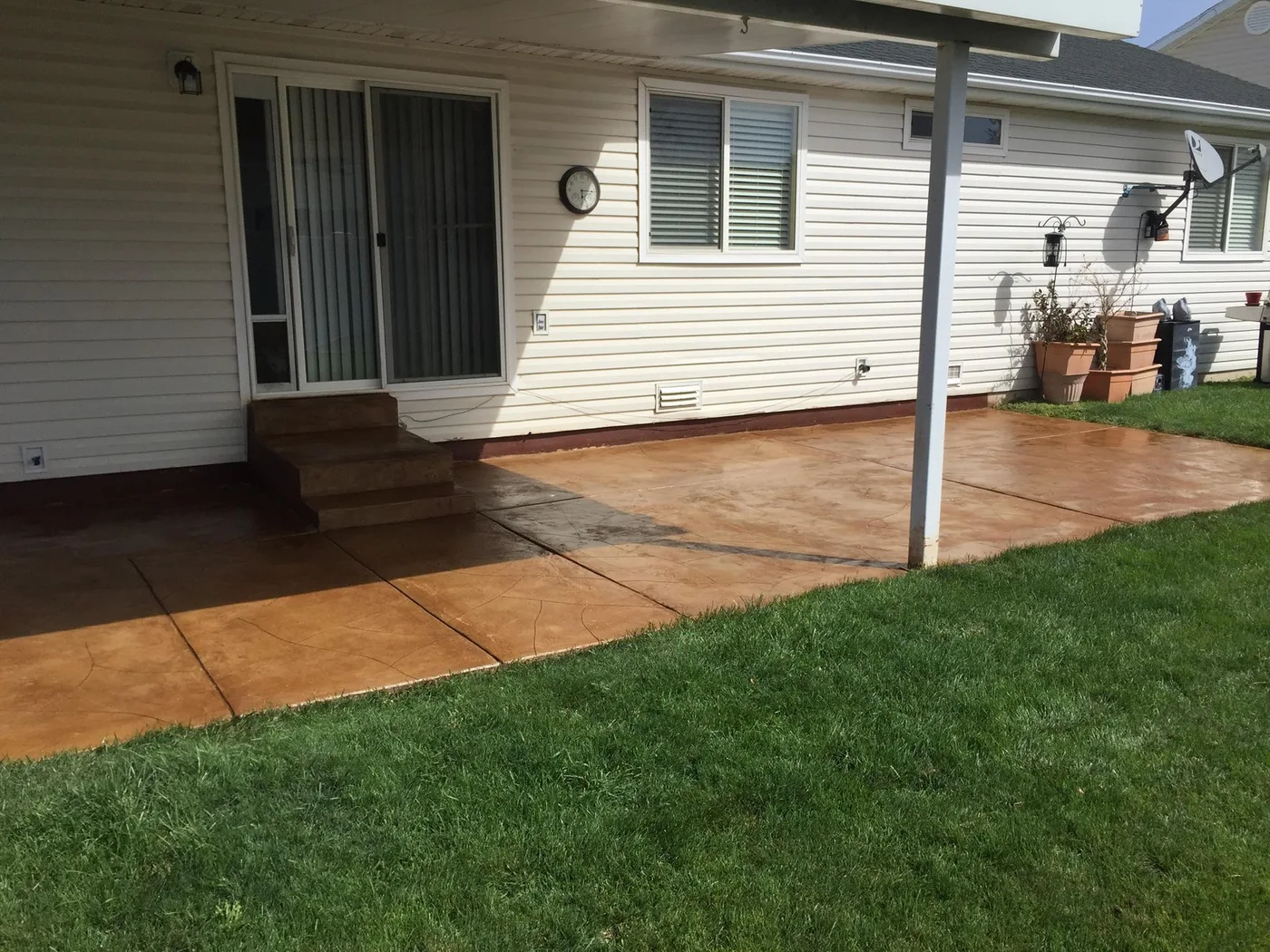
Concrete stain vs epoxy: which is better for a Utah garage, basement or patio?
Neither one wins every room. Stain soaks color into the slab and leaves the concrete showing, so it suits interior floors, porches and patios. Epoxy bonds a colored film on top that blocks oil and road salt. It suits garages, basements and shop floors. Moisture and sun decide the rest.
Complete Concrete Coatings has stained and coated Utah concrete since 2005, from our shop in Centerville. The cost ranges below come from published national guides, and each row names its source. None of them are our prices. If stain is already the direction you want, our concrete staining service page covers acid and water based color.
What is concrete stain, and what is an epoxy coating?
Stain is color that goes into the concrete. Acid stain carries metallic salts that react with the lime in the slab. Water based stain drops pigment into the open pores. Epoxy is different. It is resin and hardener that cure into a colored film bonded on top of the ground concrete.
Acid stain is the reactive one. Concrete Network describes acid stains as inorganic metallic salts dissolved in an acid and water solution. The palette is short, mostly earth tones, and most makers offer around eight hues.
Water based stain is not reactive. It fills the pores of the concrete surface with fine pigment. The color comes out more even, and the range is much wider. Blues, grays, black and white are all on the table.
Both stains need a clear sealer over the top, and that sealer is the wear layer. Epoxy works the other way around. The color sits in the film, and a clear polyaspartic or urethane top coat protects it.
Floor paint is neither one. HomeGuide calls epoxy paint mostly paint with some epoxy mixed into it. That is a thin color coat on the surface.
| Concrete stain | Epoxy coating | |
|---|---|---|
| The look | Mottled, translucent color; texture still shows | Even color, flake or metallic, under a clear coat |
| How the color is made | Acid stain reacts with the lime; water based stain fills the pores | Pigment in a resin film bonded to ground concrete |
| Hot tires | No film to lift; the sealer takes the heat | A ground in system holds; thin kits lift |
| Road salt and de-icer | Brine reaches the concrete as the sealer thins | The film keeps brine on top, where a mop gets it |
| Moisture below grade | Thin enough that water vapor keeps moving | Needs a moisture test to pass first |
| Sun and outdoors | Works outside under a UV stable sealer | Standard epoxy ambers, so outdoor floors need polyaspartic or urethane |
| Slip when wet | A smooth sealed slab is slick wet | Flake adds traction; smooth gloss is slick wet (HomeGuide) |
| Repair | Patches take stain differently and stay visible | Chips get sanded and recoated in place |
| Lifespan | 5 to 20 years, sealed every 1 to 3 (HomeGuide) | 10 to 20 years solid epoxy, 10 to 20 plus polyaspartic (HomeGuide) |
| Installed cost | $3 to $25 per sq ft (HomeGuide) | $4 to $12 per sq ft (HomeGuide) |
How does each one look on a finished floor?
They read as two different floors. Stain leaves the texture and the trowel marks showing, with mottled, translucent color that shifts across the slab. No two floors come out the same. Epoxy hides what is under it, and the color is even end to end. Flake and metallic are the other two looks.
Age, finish and mix all move the stain color. A hard troweled interior floor drinks less stain than a broom finished patio. Old patches and past cleaners shift the tone again. That is why we put a test area on your own slab first.
Old damage stays visible under stain. Patch work, oil shadows and a repaired crack all show through.
How is each one installed?
Both jobs start with the surface. The color goes down later. For stain we clean the slab, strip the old sealer and open the pores, then apply color and seal it. Acid stain gets neutralized first. For a coating we diamond grind and repair the cracks. Then a base coat, flake broadcast and a clear top coat go down.
Old sealer has to come off before stain goes down. Concrete Network is plain about it: sealers that stop the stain from soaking in have to go.
Temperature runs the stain schedule. We stain between 50 and 90 degrees F, on a dry surface. Cold leaves weak color, and heat dries the stain before it spreads.
A coating job is layers, and each layer cures before the next. Most garages are finished in 1 day. Prep decides both outcomes, so we diamond grind or sandblast every slab first.
Which one holds up better in a Utah garage?
The coating, for most Utah garages. Road salt and de-icer ride in on the tires all winter and dry to a white film. A coated floor keeps that brine on the surface where a mop gets it. Stain lets it reach the concrete once the sealer thins out. Hot tires are the other test.
Hot tire pickup has a real mechanism. Heat softens the rubber and plasticizers migrate into the coating. A patch of color comes up when the car backs out. A ground in system with a clear top coat handles it.
Stain has no film to lift, so hot tire pickup is not how it fails. It fails at the sealer, which takes the brine, the tire heat and the driveway grit.
Garage floor coatings are what most Wasatch Front garages get from us. We grind, repair the cracks and spalling, then build the floor in layers. A stained garage floor is still a real option on a sound slab.
Which one is right for a basement or a slab with moisture?
A moisture test answers that before either product does. Below grade slabs push water vapor up through the concrete. Stain and its sealer are thin, so vapor keeps moving. An epoxy film is a barrier, and vapor pushing against it causes blisters and peeling. We test damp and below grade slabs first.
Two standard tests measure it. One is the calcium chloride test, ASTM F1869. The other is a relative humidity probe set into the slab, ASTM F2170. Tnemec, an industrial coatings maker, puts the limit for most floor primers at 75 to 80 percent relative humidity.
Efflorescence is the warning sign you can see. It is a salt deposit that moisture pushes out of the concrete, and it dries to a white haze. A stained floor with that going on will blotch, and a coating will blister.
We install epoxy and metallic floors downstairs, and the basement floor coatings page covers how those jobs run. Stain works in a basement too, on a dry slab, under a sealer.
Which one belongs outdoors on a patio or porch?
Stain, with a UV stable sealer over it. Standard epoxy is the wrong chemistry outdoors. The resin has aromatic rings that absorb ultraviolet light, and the film turns amber in sunlight. Coatings that do go outside use a flake system under a clear polyaspartic or urethane top coat instead.
Ambering shows up fast. On a covered outdoor slab it is visible in 3 to 12 months. In direct sun it is measurable within weeks. The change is permanent, because the color runs through the full film.
Aliphatic polyaspartic and polyurethane resins do not absorb UV the same way, so they hold their color. That is why a clear polyaspartic or urethane goes over every color coat we install. Sun through a garage window does the same work, since UV-A passes through glass almost unchanged.
Stain outdoors has its own limit. The color sits in the top layer of the slab and wears away over time. UV fades it, and snowmelt and road salt chew on the sealer. Our concrete sealing work is what keeps an outdoor stain alive.
What does each one cost?
Published national ranges put stained concrete and epoxy in the same neighborhood. HomeGuide lists staining an existing floor at $3 to $15 per square foot installed. Epoxy flooring sits at $4 to $10. Acid stain runs wider, $3 to $25, because design work drives it. A real number for your slab needs an on-site look.
| Work | Published cost per square foot | Source |
|---|---|---|
| Stain an existing concrete floor | $3 to $15 installed | HomeGuide, 2026 |
| Acid stain | $3 to $25 installed | HomeGuide, 2026 |
| Basic one coat stain, minimal prep | $2 to $4 | Concrete Network |
| Stain with several colors and design detail | $15 and up | Concrete Network |
| Stained garage or basement floor | $5 to $25 | HomeGuide, 2026 |
| Stain on an existing patio | $3 to $10 | HomeGuide, 2026 |
| Clear sealer over the color | $1 to $3 | HomeGuide, 2026 |
| Epoxy flooring, installed | $4 to $10 | HomeGuide, 2026 |
| Garage floor coating, any type | $4 to $12 | HomeGuide, 2026 |
Concrete Network puts a basic one coat stain with light prep at about $2 to $4 per square foot. Multiple colors and design detail can run $15 per square foot or more.
Condition moves the number more than square footage does. Old sealer, glue, paint or curing compound add grinding time before any color goes down. Cracks, spalling and pitting add repair time.
How long does each one last, and what upkeep does it need?
Stain lasts as long as its sealer gets renewed. HomeGuide puts a stained floor at 5 to 20 years with regular maintenance. Sealing runs every 1 to 3 years. Coatings last on the top coat. HomeGuide puts solid epoxy at 10 to 20 years, and polyaspartic systems at 10 to 20 years or more.
Water based epoxy is the short one. The same guide puts it at 3 to 5 years. What we install is a ground in base under a clear polyaspartic or urethane. Every product goes on to the maker’s specifications.
Upkeep on stain is a sweep, a damp mop and a fresh coat of sealer on schedule. Indoors that schedule stretches out. Outdoors in Utah, sun and snowmelt work on the sealer every year.
Upkeep on a coating is a sweep and a mop. The clear top coat takes the wear, and it can be scuffed and recoated. If a ground slab is also on your list, polished concrete against epoxy covers that comparison.
Can you put epoxy over a stained floor?
Yes, after the sealer comes off. Stain color lives inside the concrete, and it stays put. The sealer on top of it has to go. Epoxy needs a bare, open profile to bond to, and it will peel off a sealed surface. We diamond grind the sealer away, then repair and coat.
The grind changes what you see. It cuts into the top layer of the concrete, where the stain color sits. Most of the color goes with the sealer, and the new coating covers the rest.
Going the other way is harder. Stain will not soak through an epoxy film, so the coating has to come off the slab completely first.
Which one should you pick, room by room?
Match the floor to what the room does to it. Garages, shops and warehouse floors get a coating. Hot tires and winter brine are the reason. Interior living floors, entries, offices and showrooms are where stain does its best work. Patios and porches go either way, on a sound, dry slab.
| Where the floor is | Usually the right call | Why |
|---|---|---|
| Garage or shop | Epoxy with a flake broadcast | Hot tires and winter brine stay on the film |
| Basement | Either one, after a moisture test | Vapor from below decides what the slab can carry |
| Interior living floor or entry | Stain under a sealer | Keeps the concrete look and the texture |
| Patio or porch | Stain with a UV stable sealer | Standard epoxy ambers in sun |
| Warehouse or commercial floor | Epoxy under a urethane top coat | Heavy traffic and chemical spills |
| Slab with cracks and old repairs | Epoxy | Stain shows every flaw, a coating covers it |
The slab decides more than the product does. We come out, measure the surface and check the concrete for cracks, moisture and old coatings. You get a written price before the crew leaves, and the estimate is free. Call (801) 347-4518 Monday through Friday, 8am to 5pm, or tell us about the floor.